
Cross Fibre Release Guide: How to Break Down Scar Tissue and Muscle Adhesions
 Apr, 12 2026
Quick Takeaways for Better Recovery
- Target: Focuses on scar tissue and adhesions rather than general muscle tension.
- Direction: Pressure is applied across (perpendicular to) the grain of the muscle.
- Goal: To restore sliding surfaces between muscle layers and improve joint range of motion.
- Feel: It can be intense; the goal is a "productive pain" that leads to immediate release.
Understanding Muscle Adhesions and Scar Tissue
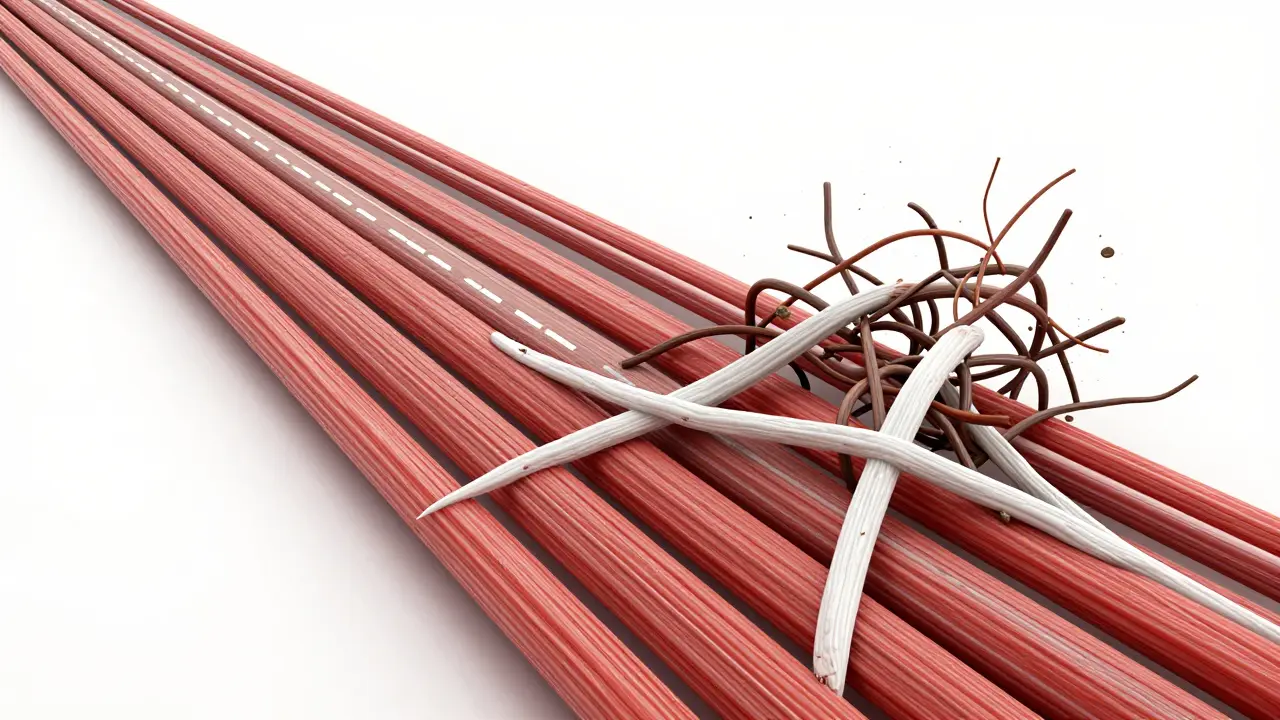
To get why this technique works, you have to understand what happens during an injury. Normally, your Skeletal Muscle fibers run in a specific direction to allow for efficient contraction. When you tear a muscle or experience chronic inflammation, the body rushes to patch the hole using Collagen. However, this emergency repair is messy. The collagen is laid down in a random, haphazard pattern, creating what we call adhesions.
Imagine a new highway being built. A normal muscle is like a multi-lane freeway where cars flow smoothly. Scar tissue is like a series of unplanned detours and dirt roads cutting across the highway. These "cross-links" prevent the muscle from sliding smoothly over the Fascia-the thin casing of connective tissue that surrounds every muscle. When this sliding mechanism fails, you lose flexibility and your risk of re-injury spikes because the tissue is no longer elastic.
The Mechanics of Cross Fibre Release
Most massage techniques use longitudinal strokes, meaning they move in the same direction as the muscle. While this is great for flushing out waste and relaxing the mind, it does very little to break up a physical blockage. Cross fibre release changes the game by attacking the adhesion from the side.
By applying a deep, focused pressure at a 90-degree angle to the fiber, you are essentially "shearing" the layers of tissue. This creates a mechanical force that pulls the abnormal collagen bonds apart. As these bonds break, the muscle can glide again. If you've ever used a Foam Roller or a massage gun on a specific "hot spot," you've likely experienced a version of this, though manual therapy with a therapist's thumb or elbow is usually far more precise.
| Feature | Longitudinal Stroke | Cross Fibre Release |
|---|---|---|
| Direction of Pressure | Parallel to muscle fibers | Perpendicular to fibers |
| Primary Goal | Circulation & Relaxation | Breaking Adhesions/Scar Tissue |
| Sensation | Soothing, gliding | Intense, "digging" sensation |
| Best For | General soreness, edema | Chronic knots, post-surgical scars |
Step-by-Step Application for Common Problem Areas
While professional help is best, you can apply basic cross fibre principles to your own recovery. The key is to move slowly and never force a movement that causes sharp, stabbing pain.
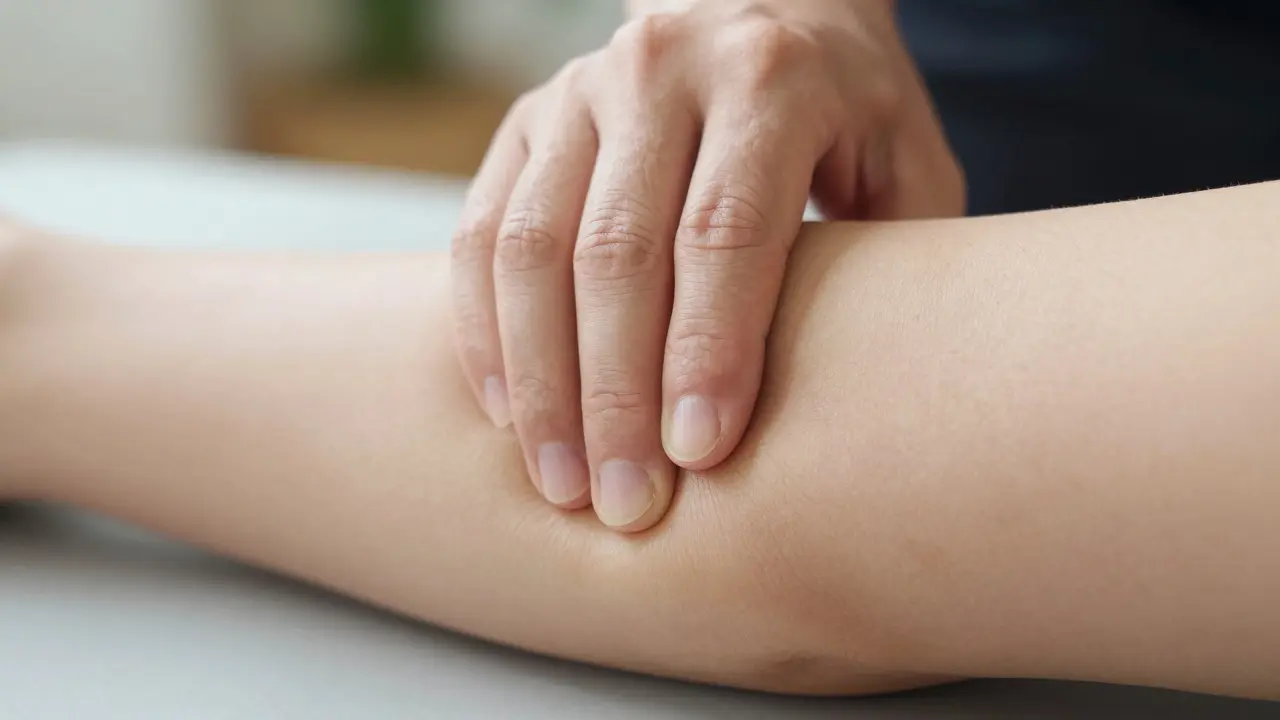
The Forearm (Common for Typists and Gamers)
- Rest your arm on a flat surface with the palm up.
- Locate the tight band of muscle in your forearm using your opposite thumb.
- Instead of rubbing your thumb up and down the arm, press firmly into the knot and move your thumb side-to-side across the arm.
- Hold the pressure for 30-90 seconds until you feel the "melt" or a softening of the tissue.
The Calf (Common for Runners)
- Sit with your leg crossed, placing the calf muscle over your thigh.
- Find a trigger point in the Gastrocnemius muscle.
- Apply a deep, perpendicular pressure. While maintaining that pressure, slowly flex your foot up and down.
- This combination of manual pressure and active movement is known as active release, which enhances the cross-fibre effect.
When to Use This Technique (And When to Stop)
Timing is everything. If you apply cross fibre release to a fresh injury-like a strain that happened two hours ago-you might actually do more damage. In the acute phase, the body is trying to create a stable clot and initial seal. Ripping that apart too early can lead to more inflammation and more scar tissue.
The ideal window for this technique is the sub-acute or chronic phase. This is when the initial swelling has gone down, but the muscle still feels "stuck" or stiff. For example, if you're six weeks post-surgery and your incision site feels like a hard ridge, cross fibre work can help flatten that scar and restore skin mobility. A good rule of thumb is the "24-hour rule": if the area is still bruised or hot to the touch, stay away. If it's cold, stiff, and limiting your movement, it's time to dig in.

Integrating Other Recovery Tools
Cross fibre release is a powerful tool, but it shouldn't be the only one in your kit. For a complete recovery, you need to support the tissue you've just "unlocked." Once you break an adhesion, that space needs to be filled with healthy, aligned fibers.
Combine your sessions with Dynamic Stretching. After the release, perform gentle movements that take the joint through its full range. This signals to the body that the new collagen should be laid down in a linear, functional pattern rather than a chaotic web. Additionally, hydration is non-negotiable. Fascia is essentially a sponge of water and proteins; if you're dehydrated, the tissue becomes sticky, and adhesions reform much faster.
Potential Pitfalls to Avoid
The biggest mistake people make is equating "more pain" with "better results." There is a specific type of discomfort associated with cross fibre release-a dull, aching sensation that eventually gives way to a feeling of lightness. However, if you feel an electric zap or a sharp, stabbing sensation, you are likely compressing a nerve, not a muscle fiber. Stop immediately.
Another common error is spending too much time on one spot. Applying intense pressure for ten minutes straight can cause bruising or local tissue trauma, which ironically leads to more scar tissue. Work in intervals: 90 seconds of focused cross-fibre work, followed by 30 seconds of light flushing strokes to encourage blood flow back into the area.
Does cross fibre release hurt?
It can be uncomfortable. Because you are manually breaking apart adhered tissue and collagen bonds, you will feel more intensity than a standard relaxation massage. However, it should not be excruciating. If you are tensing up or holding your breath, the pressure is too high, and your muscles will fight the treatment rather than release.
How often should I do cross fibre release?
For chronic issues, 2-3 times a week is usually sufficient. Overdoing it can irritate the tissue. The goal is to create a stimulus for remodeling, not to cause a new injury. Once the mobility is restored and the "knot" is gone, you can transition to general maintenance like foam rolling or light stretching.
Can I use this on a fresh scar?
Wait until the wound is fully closed and any surgical staples or sutures are removed. You should also ensure there is no active infection or open scabbing. Once the skin has epithelialized (closed over), cross fibre work can prevent the scar from adhering to the underlying muscle, which is crucial for joint mobility.
Is this different from myofascial release?
Yes, though they are cousins. Myofascial release is a broader term that often involves slow, sustained stretching of the fascia. Cross fibre release is a more specific, aggressive subset of this that targets the actual "cross-links" of scar tissue using a perpendicular shearing force.
Do I need a professional for this?
For simple muscle knots, self-care works. However, for deep-seated adhesions, post-surgical recovery, or injuries near major nerves and arteries, a licensed massage therapist or physical therapist is essential. They have the anatomical knowledge to apply the force safely without damaging surrounding structures.
Next Steps for Your Recovery Journey
If you've tried cross fibre release and still feel limited, it might be time to look at the root cause. Are you sitting in a chair for 10 hours a day? Is your running form causing an imbalance in your hips? Breaking the adhesion fixes the symptom, but changing your habit fixes the problem.
For those with severe chronic pain, consider a progression: start with heat to soften the tissue, move to cross fibre release to break the adhesions, and finish with a cool-down stretch. If the area remains stubbornly tight, a physical therapist can use instruments like the Graston tool-essentially a stainless steel version of cross fibre release-to get deeper into the tissue than a thumb ever could.