
Rolfing: A Revolutionary Approach to Body Alignment
 Dec, 21 2025
Imagine walking into a room and everyone notices how you carry yourself-not because you’re tall or stylish, but because you move like you’re floating. No tension in your shoulders. No ache in your lower back. No need to adjust your posture every five minutes. That’s what rolfing can do. It’s not just another massage. It’s not stretching. It’s not yoga. Rolfing is a hands-on system designed to realign your body with gravity, so you stop fighting yourself just to stand up straight.
What Exactly Is Rolfing?
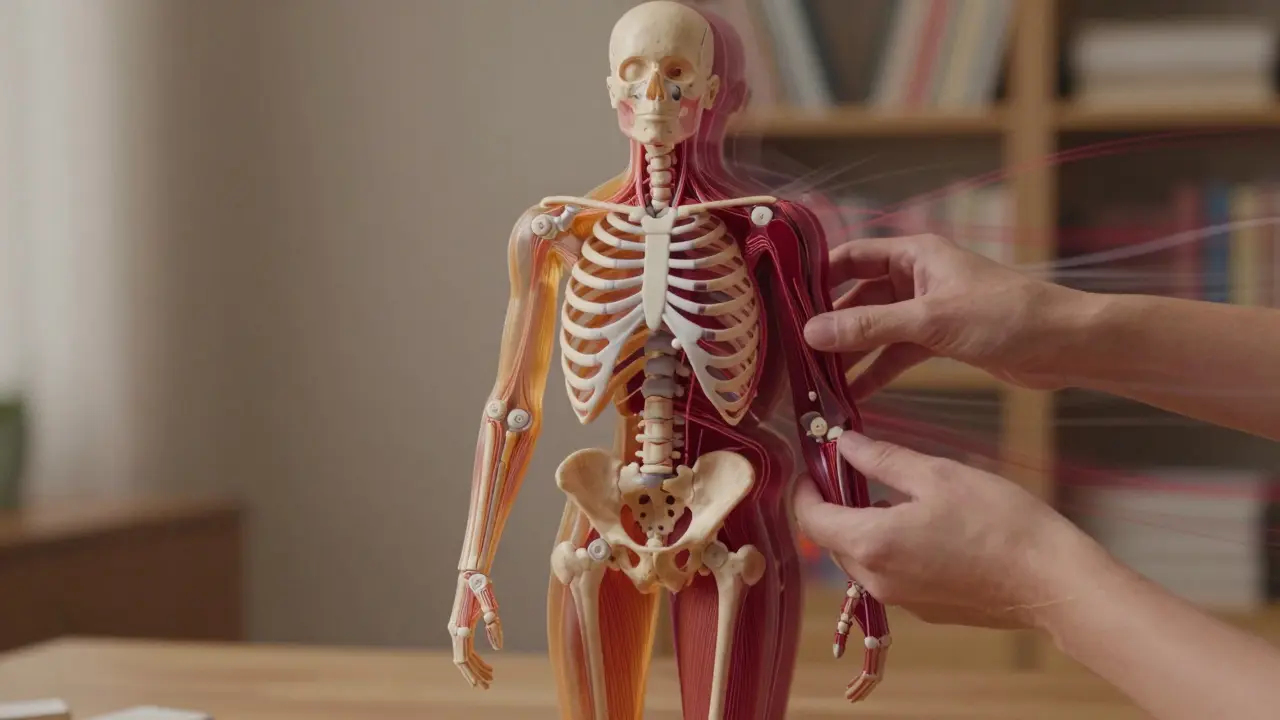
Rolfing, also known as Structural Integration, was developed by Dr. Ida Rolf in the 1940s. She was a biochemist who noticed that people with chronic pain often had bodies that were out of balance-not because of injury, but because of how their connective tissue, called fascia, had tightened over time. Fascia wraps around every muscle, bone, nerve, and organ. When it gets stuck or twisted from sitting too long, standing unevenly, or even emotional stress, your whole structure shifts.
Rolfing works by applying slow, deep pressure to this fascia, releasing adhesions and reorganizing the body’s segments-head, shoulders, spine, hips, legs-so they stack neatly on top of each other. Think of it like straightening a crooked stack of books. You don’t just push the top book down. You fix the whole pile so it stands on its own without tipping.
How Rolfing Differs from Massage
Most massage focuses on relaxation. You lie down, someone kneads your muscles, you feel better for a day or two. Rolfing is different. It’s not about temporary relief. It’s about permanent change. A typical Rolfing session lasts 75 to 90 minutes. The practitioner doesn’t just work on your tight hamstrings-they look at how your tight hamstrings are pulling your pelvis forward, which is arching your lower back, which is pushing your head too far forward. It’s a chain reaction.
Also, Rolfing usually follows a structured series of ten sessions, called the Ten-Series. Each session targets a different part of the body, building on the last. Session one might focus on your breathing and ribcage. Session five might work on your hips and legs. By session ten, your body has been re-educated to hold itself in a new, more efficient alignment. It’s like upgrading your body’s operating system.
The Science Behind Rolfing
For years, Rolfing was dismissed as pseudoscience. But in the last decade, research has started catching up. A 2020 study published in the Journal of Bodywork and Movement Therapies found that participants who completed a Rolfing series showed significant improvements in posture, reduced lower back pain, and better balance compared to a control group. Another study from 2023 at the University of Vienna tracked changes in fascial thickness using ultrasound and confirmed that Rolfing reduced fascial stiffness by an average of 32% after ten sessions.
The mechanism? Fascia is alive. It’s not dead tissue. It contains nerve endings, blood vessels, and even muscle cells called myofibroblasts. When pressure is applied slowly and intentionally, these cells respond by loosening their grip. It’s not about breaking down scar tissue-it’s about signaling the tissue to relax and reorganize.
What Happens in a Typical Session
Unlike massage, Rolfing doesn’t happen on a table with candles and lavender oil. The practitioner will often ask you to stand, walk, or even squat during the session. They’ll observe how you move, where you favor one side, how your feet turn in or out. Then they’ll begin working-sometimes gently, sometimes firmly. It can hurt, but it’s not supposed to be unbearable. Think of it like deep pressure during a good stretch: uncomfortable, but in a way that says, “Ah, this is where I’ve been holding on.”
One client I spoke with in Melbourne described it like this: “It felt like my spine was being untwisted. I didn’t cry, but I definitely gasped a few times.” After session three, she noticed she no longer needed to lean on the counter while washing dishes. After session seven, she stopped buying new shoes because her feet weren’t wearing them unevenly anymore.
Who Benefits Most from Rolfing?
Rolfing isn’t for everyone. But if you fit one of these profiles, you’ll likely see real results:
- You have chronic pain that hasn’t responded to physical therapy or chiropractic care
- You sit at a desk all day and feel like your body is collapsing inward
- You’ve had injuries (sports, car accidents, falls) that left you compensating for years
- You’re an athlete or dancer trying to improve movement efficiency
- You feel tired all the time, and you think it’s stress-but it might be your body working overtime to stay upright
People with severe osteoporosis, recent fractures, or active inflammation should avoid Rolfing. If you’re pregnant, it’s best to wait until after delivery. But for most healthy adults, it’s safe-even if it’s intense.
Real Results: Before and After
One client, a 58-year-old teacher from Brighton, came in with sciatica and a 15-degree forward head posture. She’d been using a cervical pillow and doing stretches for two years with no change. After six Rolfing sessions, her posture improved by 11 degrees. Her sciatica vanished. She started walking her dog again without painkillers. She didn’t just feel better-she looked different. Friends asked if she’d lost weight. She hadn’t. She’d just aligned.
Another case: a 32-year-old runner with IT band syndrome. She’d tried foam rolling, strength training, orthotics. Nothing stuck. Rolfing addressed the tightness in her outer hip fascia, which was pulling her knee out of alignment. After ten sessions, she ran a half-marathon without pain. Her coach said her stride looked “lighter.”
Is Rolfing Worth the Cost?
A single session in Melbourne costs between $150 and $220. The full Ten-Series runs between $1,500 and $2,200. That’s not cheap. But consider this: if you’re spending $80 a week on massage, $120 on physio, and $50 on painkillers every month, you’re already spending $2,760 a year. Rolfing is an investment that stops the cycle. You don’t need ongoing treatments. Once your body learns its new alignment, it tends to hold it.
Some insurance plans in Australia cover Rolfing under “remedial massage” if provided by a registered practitioner. Check with your provider. Many clinics offer payment plans.

What to Look for in a Rolfing Practitioner
Not everyone who presses on your back is a Rolfing practitioner. True Rolfers are certified by the Rolf Institute of Structural Integration in Boulder, Colorado. They complete over 700 hours of training, including anatomy, movement analysis, and hands-on practice. Look for the official Rolf Institute logo on their website or clinic.
Ask: “Do you follow the Ten-Series structure?” If they say, “I just do deep tissue,” they’re not a Rolfer. They’re a massage therapist. The structure matters.
What Comes After Rolfing?
Once you’ve completed the Ten-Series, you’re not done. You’re just beginning. Your body now has the blueprint for better alignment. But old habits die hard. You’ll need to move differently. Some people take a few maintenance sessions every six months. Others just start paying attention to how they sit, stand, and walk.
Simple things help: standing on both feet evenly. Not crossing your legs for hours. Carrying bags with both shoulders. Walking barefoot on grass when you can. Your body remembers what you teach it.
One of my clients, a graphic designer, started doing “posture checks” every hour. She set a timer. When it went off, she’d pause, feel her feet on the floor, and reset her spine. Within weeks, her neck pain disappeared. She didn’t need another session.
Final Thoughts: Is Rolfing for You?
Rolfing isn’t magic. It’s not a quick fix. But if you’re tired of treating symptoms instead of the root cause-if you’re ready to stop compensating and start moving like your body was meant to-then it’s one of the most powerful tools you can try.
You don’t need to be in pain to benefit. You just need to be ready to feel your body differently. And sometimes, that’s all it takes to change everything.
Is Rolfing painful?
Rolfing can be intense, but it shouldn’t be unbearable. Practitioners work within your comfort zone and adjust pressure based on your feedback. Most people describe it as a deep, satisfying release-not pain. If it feels like sharp or burning pain, speak up. That’s not normal.
How long do the results last?
Results from the full Ten-Series typically last for years. Many people report lasting changes for 5 to 10 years, especially if they maintain good movement habits. Your body doesn’t forget the new alignment-it just needs reminders through mindful movement and posture.
Can I do Rolfing at home?
You can’t replicate Rolfing at home. It requires trained hands to detect and release deep fascial restrictions. Foam rollers and massage balls help with surface tension, but they can’t reorganize your structural alignment like a certified Rolfer can.
Does Rolfing help with stress?
Yes. When your body is misaligned, your nervous system stays in a state of low-grade alert. Rolfing reduces physical tension, which signals your brain that you’re safe. Many clients report feeling calmer, sleeping better, and thinking more clearly after just a few sessions.
How do I find a certified Rolfer near me?
Visit the official Rolf Institute website and use their practitioner directory. In Australia, certified Rolfers are listed in Melbourne, Sydney, Brisbane, and Perth. Always verify certification-look for the Rolf Institute logo and training completion date.