
Relieve Your Pain with the Power of Trigger Point Massage
 Mar, 15 2026
Ever feel like a knot in your shoulder won’t quit, no matter how much you stretch or roll around on a foam roller? Or maybe your lower back tightens up every time you sit for more than 30 minutes, even if you’re not stressed? That’s not just tension-it’s likely a trigger point. And the most direct way to melt it away isn’t a pill, a heat pack, or even a deep tissue massage from someone else. It’s trigger point massage.
What Exactly Is a Trigger Point?
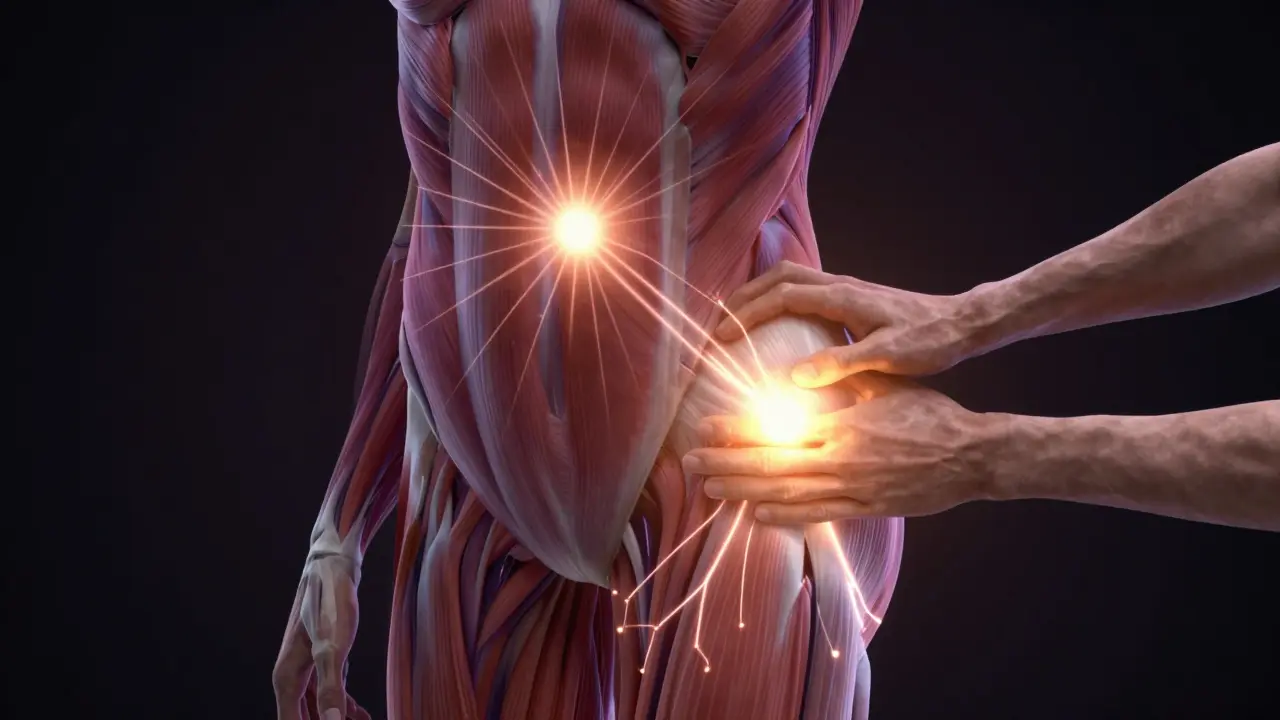
A trigger point is a tiny, hyperirritable spot in a muscle that feels like a hard pea under your skin. It doesn’t just hurt where it is-it refers pain to other places. For example, a trigger point in your upper trapezius muscle (the muscle that runs from your neck to your shoulder) can make your temple throb like a headache. A knot in your gluteus minimus? That can shoot pain down your leg, mimicking sciatica. These aren’t imaginary. Studies using ultrasound and pressure mapping show they’re real, measurable areas of muscle dysfunction.
They form because muscles get stuck in a state of constant contraction. Maybe you sat at a desk for years with your shoulders hunched. Or you carried a heavy bag on one side. Or you ran too much without stretching. The muscle fibers clamp down, blood flow drops, and waste products build up. That’s the trigger point. And it keeps sending pain signals to your brain-even when you’re not moving.
Why Trigger Point Massage Works When Other Things Don’t
Stretching? It helps, but if the muscle is locked tight, stretching just pulls on the whole chain and makes things worse. Heat? It relaxes the surface, but doesn’t reach the deep knot. A general massage? A therapist might miss the exact spot. Trigger point massage is different. It’s targeted. You find the spot. You press into it. You hold. And you wait.
Here’s the science behind why it works: when you apply steady pressure to a trigger point for 30 to 60 seconds, you’re not just pushing on muscle-you’re resetting the nervous system. The muscle spindle fibers that keep the muscle contracted start to quiet down. Blood flow rushes back in. The built-up lactic acid and inflammatory chemicals get flushed out. Within minutes, the knot softens. The referred pain fades. You feel like you just took a weight off your body.
How to Find Your Own Trigger Points
You don’t need a therapist to start. Most people can find their own trigger points with a little patience. Here’s how:
- Start with the area where you feel pain. Don’t just focus on the pain site-look nearby. Trigger points often refer pain several inches away.
- Use your fingers, a tennis ball, or a lacrosse ball. Roll slowly over the muscle. When you hit a spot that makes you wince, stop. That’s it.
- Press into it gently at first. If it’s too painful, back off slightly. You want discomfort, not agony. Think "hurts good," not "stop now."
- Hold the pressure for 45 to 60 seconds. Breathe. Don’t hold your breath. You’ll feel the pain dull, then shift, then fade.
- Repeat 2 to 3 times a day for 3 to 5 days. Consistency matters more than intensity.
Common trigger point zones: the base of your skull (headaches), the side of your hip (buttock pain), the inside of your calf (foot arch pain), and the front of your shoulder (referred arm pain). If you’ve had chronic pain in any of these areas, you’ve probably had trigger points for years without knowing it.
Tools You Can Use at Home
You don’t need fancy gear. But a few simple tools make it easier:
- Tennis ball: Perfect for the back, glutes, and feet. Roll it against a wall.
- Lacrosse ball: Firmer than a tennis ball. Better for deep muscles like quads or lats.
- Massage stick or foam roller: Good for long muscles like calves or hamstrings.
- Theracane or massage wand: Lets you reach your upper back and shoulders without help.
One of the most underrated tools? Your own knuckles. If you can’t reach a spot with a ball, curl your fingers into a fist and press in. It’s crude, but it works.
When to Stop-And When to See Someone
Trigger point massage is safe for most people. But there are signs you should pause:
- If the pain gets worse after 3 days of consistent work.
- If you feel numbness, tingling, or sharp shooting pain.
- If you have osteoporosis, recent fractures, or open wounds in the area.
- If you’re on blood thinners-don’t use deep pressure without checking with your doctor.
If you’ve tried for a week and nothing’s changed, it might not be a trigger point. It could be a pinched nerve, joint issue, or something else. That’s when you see a physical therapist or a certified myofascial release practitioner. They’ll use tools like dry needling or manual therapy to get deeper.

Real Results From Real People
I’ve seen this work over and over. A teacher in Brisbane came in with daily neck pain and headaches. She found two trigger points under her jawline-right where her phone pressed against her shoulder. After two weeks of daily 60-second presses with a tennis ball, her headaches dropped from 5 days a week to 1. A construction worker with chronic lower back pain? He had a knot in his piriformis muscle. Once he started rolling it with a lacrosse ball every morning, his sciatica-like pain vanished. No surgery. No pills. Just pressure and time.
Trigger point massage doesn’t fix everything. But it fixes a lot of what other therapies overlook. It’s not a miracle. It’s a mechanism. And once you learn how to use it, you’re no longer at the mercy of pain.
Make It Part of Your Routine
Think of trigger point work like brushing your teeth. You don’t wait until your tooth hurts to do it. You do it daily. Same here. Spend 5 minutes after your shower. Before bed. Right after work. Roll out your shoulders. Press into your hips. Work your calves. It’s not about relaxation-it’s about maintenance.
And here’s the best part: you don’t need to book an appointment, pay $100, or wait weeks for a slot. You can do it right now. Grab a ball. Find the spot. Press. Breathe. Wait. And feel the tension dissolve.
Can trigger point massage cause bruising?
Mild bruising can happen if you press too hard or too long, especially on sensitive areas like the thighs or shoulders. It’s rare with proper technique. If you’re bruising often, you’re applying too much force. Ease up. Use a softer tool. Let the pressure build slowly. Bruising isn’t a sign it’s working-it’s a sign you’re going too far.
How long does it take for trigger point massage to work?
Some people feel relief in under a minute. Others need 3 to 5 days of consistent work. It depends on how long the trigger point has been there. A new knot from yesterday? Might vanish in one session. A knot from years of bad posture? Takes daily attention for a week or more. Patience beats intensity every time.
Is trigger point massage the same as deep tissue massage?
No. Deep tissue massage works on broad areas of muscle tension using broad strokes and lots of pressure. Trigger point massage targets one tiny spot with focused, sustained pressure. One is a full-body session. The other is a precision tool. You can do trigger point work as part of deep tissue, but they’re not the same thing.
Can I use trigger point massage for headaches?
Yes-especially tension headaches. The most common trigger points for headaches are in the suboccipital muscles (at the base of your skull) and the upper trapezius. Pressing these for 60 seconds, twice a day, can cut headache frequency by half in as little as a week. Many people stop needing painkillers after starting this routine.
Do I need to stretch after trigger point massage?
Yes, but gently. After releasing a trigger point, the muscle is more pliable. Do light stretches-hold each for 20 to 30 seconds. Don’t bounce. Don’t push hard. The goal is to help the muscle remember its full length. Stretching after helps lock in the relief.
Next Steps
Start today. Pick one area that’s been bothering you-your neck, your hip, your foot. Grab a ball. Find the spot. Press. Hold. Breathe. Repeat tomorrow. In a week, you’ll notice things you didn’t even realize were pain: the way you sit, the way you walk, the way you sleep. You’ll feel lighter. And you’ll realize you’ve been carrying that tension for years. Now, you know how to let it go.